Rosenblatt Swarms — GTM Framework · Internal

The Swarm Flywheel, from content to closed project.

A map of how one idea becomes attention, attention becomes a conversation, and a conversation becomes a paid engagement — with the data that flows at every step. The insight worth building around: the same swarm we sell also runs the funnel. That's what lets us give proof away, price below competitors, and still carry more clients than a traditional shop.

ADVANTAGE 01
Price below the market
Swarm delivery costs a fraction of a human team, so our profitable floor price sits under a competitor's.
ADVANTAGE 02
Carry more clients at once
One coordinator — the hive — runs many swarms in parallel. Capacity isn't headcount-bound.
ADVANTAGE 03
Give the first win away
If a lightweight solve is nearly free to produce, free proof becomes our best salesperson.
Stage by stage

Trace the data through each step

Each stage takes something in, produces an asset it hands forward, and captures a signal it feeds back. The colored spine on the left is the data thread — follow it top to bottom; the next section pulls back to show the seven as a single loop.

1
Top of funnel · Awareness

Create

Turn our expertise and past results into points of view, short problem→outcome stories, and the hive page itself.
Why it matters: we can't distribute what doesn't exist. This is the fuel tank for the whole wheel — and where our real engagements become marketing.
Asset produced →
  • POV posts, tagged by problem type
  • Case stories (problem → outcome)
  • The "Explore the Hive" page
← Signal captured
  • Which themes we have proof for
  • A reusable, versioned content library
Swarm role: a research + draft swarm produces content at volume for near-zero marginal cost — so we publish daily, not weekly.
2
Top of funnel · Awareness

Distribute

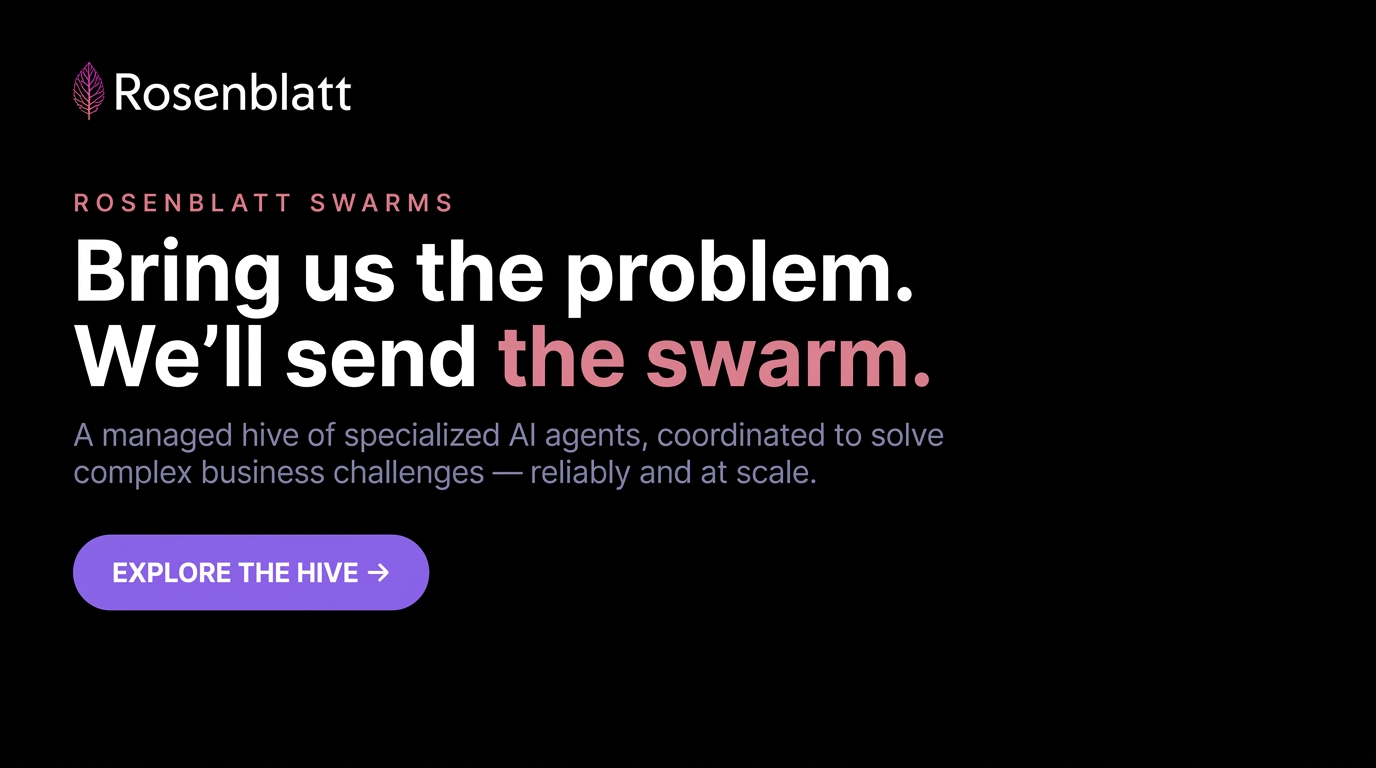
Publish to the channels our buyers already read. Every post carries the same hook and the same one CTA: Explore the Hive →. ← this is the hook creative — see it in "The CTA assets" below.
Why it matters: creation without distribution is a diary. One consistent call-to-action per post is what turns a reader into a click.
Asset produced →
  • Scheduled posts w/ tracked links
  • Hook → CTA → hive-page journey
← Signal captured
  • Reach, clicks, comments per post
  • Which problem type resonates
  • → Stage 1: make more of what works
Swarm role: reformat one story into many channel-native posts, and read engagement to decide what to write next.
3
Middle of funnel · Interest

Contact

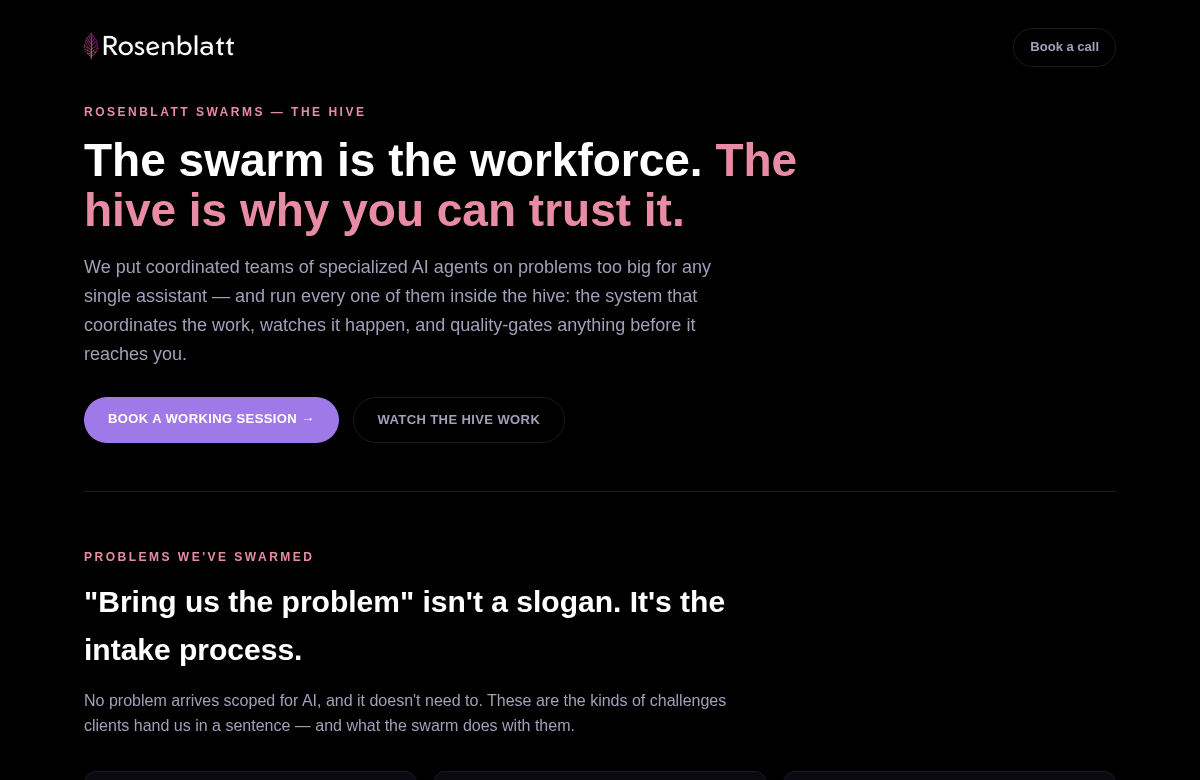
The click lands on the hive page, which converts curiosity into one action: bring us the problem — a booked call or a short problem description. ← this is the hive page — see it in "The CTA assets" below.
Why it matters: this is where an anonymous reader becomes a named lead. The problem they type is the single most valuable thing we collect — the seed of the sale.
Asset produced →
  • The hive page as the destination
  • Intake form / calendar booking
← Signal captured
  • Name, company, contact
  • The problem, in their words ★
  • Source post (which content earned it)
Swarm role: the page proves governance (the hive trace) so a skeptical buyer self-qualifies before we ever speak.
4
Middle of funnel · Interest

Qualify

Score each problem on two axes: is it a fit (can a swarm actually solve it?) and how big (lightweight demo, or full paid engagement?). Then route it.
Why it matters: our time is the scarce resource, not the swarm's. Qualification decides who gets a free proof and who goes straight to a proposal.
Asset produced →
  • Qualified opportunity record
  • Estimated swarm cost-to-deliver
← Signal captured
  • Fit score, problem size, urgency
  • Budget signal / decision-maker
Swarm role: because delivery is cheap, our "yes, it's a fit" bar can sit lower than a competitor's — more problems are economical to take on.
The fork: qualification splits the road. This is our land-and-expand wedge.
Lightweight → Prove (free) A small, self-contained slice the swarm can solve in hours. Give it away to earn trust and a foot in the door.
Substantial → straight to Sell A clearly-scoped, budgeted problem. Skip the freebie; go to proposal with a proof story from a past engagement.
5
Bottom of funnel · Decision

Prove

Run a lightweight swarm on a real slice of their problem — for free or near-free — and hand back an actual result plus the hive trace showing how it was governed.
Why it matters: this is a loss leader. A prospect who has watched the swarm solve their own problem is no longer buying a promise. The demo does the selling — and even a proof that never closes is still publishable content, so this stage always pays off.
Asset produced →
  • A real, usable result
  • Hive trace (governance shown)
  • → Stage 1: a new case story ★ — even if it never sells
← Signal captured
  • Actual cost + time to deliver
  • Prospect reaction / objections
  • Scope signals for the paid version
Swarm role: this stage only exists because the swarm makes proof cheap — the advantage a human-team competitor structurally can't copy.
6
Bottom of funnel · Decision

Sell

Turn the proof into a scoped, priced engagement — the full version of what they just watched work. Price below the market because our delivery cost is below the market.
Why it matters: this is the money step. A low price only wins if margin survives it — and swarm economics are what let us undercut and still profit.
Asset produced →
  • Proposal / statement of work
  • Pricing anchored to swarm cost
← Signal captured
  • Win / loss + the reason
  • Price accepted, cycle length
  • → Stage 4: win/loss sharpens qualifying & pricing
Swarm role: lower cost-to-deliver = a price a competitor can't match without losing money.
7
Post-sale · Deliver & expand · The loop closes

Deliver & Expand

The hive delivers the engagement, running many client swarms in parallel. A satisfied client is the start of the next sale — new problems, referrals, and a fresh outcome to write about.
Why it matters: retention and referral are cheaper than new leads. And every delivered result is a new case story — exactly what Stage 1 needs. The wheel closes here.
Asset produced →
  • Delivered outcome + metrics
  • → Stage 1: a new case story ★ (the wheel closes)
  • Referral / expansion opening
← Signal captured
  • Result magnitude (the next stat)
  • Delivery cost at scale
  • Satisfaction / referral likelihood
Swarm role: one hive supervises many concurrent engagements — the "more clients at once" advantage in action.
The loop, all at once

It's a flywheel, not a funnel

We just traced the seven stages top to bottom — but they aren't a line, they're a loop. A funnel ends at the sale; this doesn't. Every project we deliver produces a result, and that result is the raw material for the next round of content — so the wheel spins faster each turn because we learn what works and stop guessing.

5→1 proof→content 2→1 what resonates 6→4 win/loss→fit THE SWARM one engine, every turn 1 Create 2 Distribute 3 Contact 4 Qualify 5 Prove 6 Sell 7 Deliver

↺ The wheel closes 7 → 1 — every delivered outcome becomes the next case story

FORWARD →The sequence — follow 1 → 7 clockwise. Each stage hands its asset to the next.
↺ FEEDBACKOutput that loops back to an earlier stage (the dashed pink arcs) and makes the next turn cheaper and sharper.

Three feedbacks do the real work. Deliver (7) and Prove (5) both refill Create (1) with fresh case stories — and here's the one that's easy to miss: a lightweight proof is publishable content even if it never turns into a sale. Meanwhile Sell (6) feeds Qualify (4), so every win and loss sharpens who we chase next.

Our three advantages, placed on the map

Where the swarm changes the math

We named three edges the swarm gives us. Each acts at a specific point in the wheel — knowing where keeps the story precise instead of a vague "AI is cheaper."

Advantage 01

Price below the market

Delivery by swarm costs a fraction of a human consulting team. Our profitable price floor sits under a competitor's break-even.

Acts at → Stage 6 · Sell
Advantage 02

More clients at once

The hive coordinates many swarms in parallel, so capacity scales with orchestration, not hiring. More concurrent engagements, same core team.

Acts at → Stage 7 · Deliver (and funds Stage 5)
Advantage 03

Give the first win away

When a lightweight solve is nearly free to produce, a free proof is cheaper than most ad clicks — and converts far better.

Acts at → Stage 5 · Prove
The CTA assets, in place

The assets we built are stages 2 and 3

This isn't theory — the Distribute and Contact assets from the stages above already exist. The hook creative is the Distribute asset; the hive page is the Contact destination. Here's how they sit in the flow, so the team knows what each one is for.
Stage 2 · Distribute — the hook
Marketing post creative
Bring us the problem. We'll send the swarm. — Explore the Hive
Goes out on LinkedIn, email, decks. Its only job is to earn the click — one hook, one CTA: Explore the Hive →.
click
Stage 3 · Contact — the destination
The hive landing page
hive.share.rosenblatt.ai
The hive landing page — preview
Where the click lands. It demonstrates governance (the hive trace) and converts curiosity into a captured problem. Open the live page →
What to actually measure

One number per stage, to start

New to this? Don't track everything. Watch one leading metric per stage — if a number is weak, we know exactly which stage to fix instead of guessing.

StageLayerThe one metric to watchWhat a weak number tells us
1 · CreateTOFUPublishing cadence (posts / week)The wheel has no fuel — nothing to distribute.
2 · DistributeTOFUClick-through rate to the hive pageHook or channel is wrong; reach isn't converting to interest.
3 · ContactMOFUPage → intake conversion %The page earns clicks but not problems; CTA or trust gap.
4 · QualifyMOFU% of leads that are a fitWe're attracting the wrong buyers; retarget content.
5 · ProveBOFUProof → paid conversion %The free solve isn't compelling, or scope is unclear.
6 · SellBOFUWin rate & average project pricePricing or proposal is off; check win/loss reasons.
7 · DeliverLOOPReferral / expansion rateDelivery satisfies but doesn't compound; wheel won't spin up.
Plain-language glossary

The terms that'll come up

TOFU / MOFU / BOFU
Top / Middle / Bottom of funnel — how close someone is to buying. Awareness → interest → decision.
Loss leader
Something we give cheap or free because it reliably leads to a paid sale. Our free "Prove" solve is one.
Land and expand
Win a small first engagement, then grow the account. The free proof is the "land"; Stage 7 is the "expand."
Lead qualification
Deciding which prospects are worth our time before we invest in them. That's Stage 4.
Flywheel
A loop where each turn makes the next easier — outcomes become content, content becomes leads, leads become outcomes.
CTA
Call to action — the single next step we want a reader to take. Ours is "Explore the Hive."
A note on what's assumed: this framework maps the motion; it doesn't validate the economics. Before pricing below the market, confirm our real swarm cost-to-deliver on a couple of engagements — the "give it away" and "undercut" moves only work if the margin is actually there.